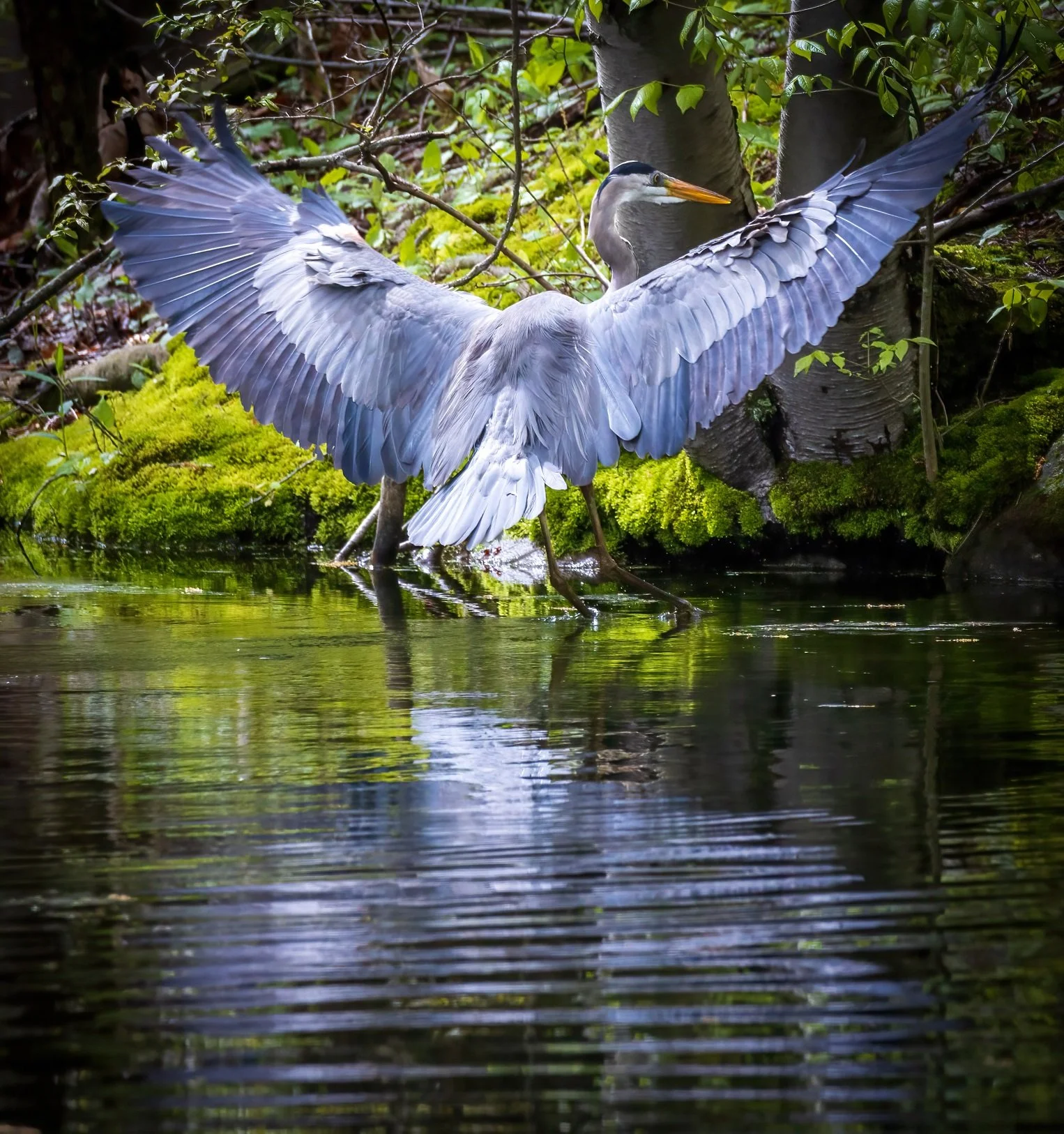
Wingspread and Reflection: The Great Blue Heron
Photographed by my friend, Rabbi Dr. Julie Danan, I chose the Great Blue Heron as the “Guardian of the Gateway” to my site for its rich spiritual symbolism in diverse cultures. There is none better suited to be my symbolic “keeper of the crossing.”
The Great Heron is one of those creatures that seems to exist at the threshold — not quite of the water, not quite of the sky, at ease in all the in-between places. In many Indigenous North American traditions, the heron is a symbol of self-reliance, patience, and the courage to follow one's own path rather than the way of the flock. The heron doesn't hunt in groups; it stands alone, still, watchful, and strikes with precision when the moment is right. For many peoples, this made it a totem of wisdom earned through solitude, of knowledge that comes not from rushing but from deep, unhurried attention.
In ancient Egyptian tradition, a great wading bird believed to be the heron's ancestor — the Bennu — was associated with the god Thoth and with the soul's journey between worlds. It was said to be one of the first creatures to land on the primordial mound at the moment of creation, a harbinger of new life emerging from still waters. This liminal quality of standing between the world of the living and what lies beyond echoes across cultures. In Celtic symbolism, herons were associated with the Otherworld and with guardianship of sacred boundaries. They were neither of this realm nor of the next, but keepers of the crossing itself.
The heron's posture alone carries spiritual meaning: that long, patient stillness before the strike, the way it waits without agitation, reads as a kind of embodied contemplative practice. Many traditions see in the heron a model for the inner life — watchful but undisturbed, present to what is moving beneath the surface, unafraid of wading into deep or murky waters.
For the "Gateway" to my home page, the symbolism is obvious. A gateway, by its nature, is a threshold — a place of transition, passage, and becoming. The heron stands precisely at those edges: between water and land, between silence and movement, between grief and what might come after. Our heron signals that this is a place where the in-between is honored — where people are met exactly where they stand, at the water's edge, ready to explore.