
Many Spiritual Caregivers recommend writing about your life to better understand yourself and help others know you. A simple way to begin is to ask, "What legacy do I want to leave in writing?" Sharing a few learned lessons could be a meaningful gift to your family and perhaps to others you care about.
Writing is a form of art I prefer, so it’s not terribly difficult for me - but I do struggle with organization. Here’s a simple Legacy Project I undertook a while back. If the format makes sense to you, why not give this form of reflection a try? Here are two sample essays in which I share personal stories highlighting lessons learned in the art of spiritual resilience.
Legacy Project Part I: Feet Find Ground
Rewriting this recently, I met my survivor's guilt by name for the first time in all my decades of life.
“My list of regrets may seem unusual, but who can know that they are, really. This is an interesting planet. It deserves all the attention you can give it.” ~ Marianne Robinson, Gilead
And we deserve some attention paid to our interesting lives, too. Success stories are easy to remember. Regrets haunt us as we grow older. Dealing with them through the years has been quite the journey. At my age, there is so much I want squared away before I dissolve into the ether - not because I fuss over the details of what does or doesn’t happen next but because I care about my legacy as a person. I think of it as smoothing the blanket before I lie in it.
When I first began, I quickly jotted down as many personal regrets as I could at a sitting. I understood the list would never be complete, but figured I’d rank them to unearth which regret I experienced as the mother of them all.
What would such a regret even look like? I scoured the list. In the process, I found a few more regrets. Buzzed with an onslaught of incidents from decades ago and more recently, I became painfully aware of times I could have or should have done better. Then I looked up the dictionary definition of regret.
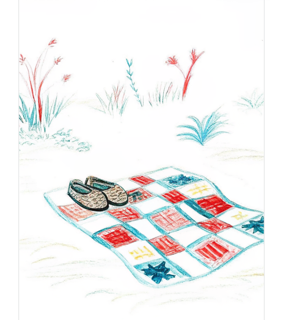
Considering the subtleties and shadings of the word “regret” helped. Sadness, repentance, and disappointment are all built-in features of regret. Shame and/or guilt aren’t necessarily bad - their teachings can pierce your heart and soften you up. This new understanding kept me from over-indulgence in my old Catholic school training, where I picture myself wrapped in a “guilt quilt”—a mental image of self-imposed shame and ultimate responsibility for the whole package of everything and everyone. “Mea culpa, mea maxima culpa…I am responsible for the sins of the world.” The lingering shame from times I fell short had become an obstacle I needed to overcome to find the relief I sought in the lessons I’d absorbed, and there have been quite a few.
This exercise, reframed, has enabled me to examine the stains on my guilt quilt. I’ll explain what sounds kind of gross and messy: the quilt’s patches are my past experiences, shaped by circumstances often beyond my direct or conscious control. The stains are shame, pain, and regret, tied to memories that often begin with “if only I…” Some of our hardest struggles come from within. Self-disregard can become a habit learned early.
Full disclosure, the quilt itself will remain a part of me, folded and stored in the quietest corner of my mind, as it should; it represents my basic humanity. When I try to carry the whole thing at once, it feels overwhelming. Each patch on the quilt represents an experience or lesson; it’s best to reflect on them one at a time. In each, I find lessons, small comforts, and sometimes insight. My life has not been perfect, but I have loved it in my way. How do I know? I was born with a good deal of awareness, which, in turn, confers insight; another story for another day.
So, what is the greatest of all my regrets? It resides at the center of my life story.
My deepest regret is the time I so desperately wanted to be someone other than myself. The event shocked me with its ferocity and made me consider life as I never had before. I was thirteen years old, sitting on my bed, contemplating my aching feet (my shoes had always been too tight on my big feet), when I was overcome with a hatred of both life and myself. I surveyed the vast distance between the happy times of the past and the devastation of my particular here-and-now. I’d never seriously considered suicide, but for the first time, I understood why some people went through with the act.
That day, I considered how it could be done. My mom often threatened to put her head in the gas oven, and I thought that might be painless. But I couldn’t see myself doing it. I didn’t dare to leave the world for the unknown. What would my little sisters do? So much for faith, I thought. Maybe not acting meant I had too little or too much faith. I don’t know.
One of my two grandfathers had recently died. My father’s father. A proud redneck kind of guy – he literally showed it off with his open-collared shirts - he’d loved me, the first grandchild, first baby girl of the family. From the distance of a truck driver’s job, he oversaw the hell of an ever-worsening family situation. Knowing how badly things were headed, he’d started making surprise visits to our home in the middle of the day. I remember him needing to park on a nearby road and walk to our house because the residential streets couldn’t support the weight his rig carried.
He died quickly after a sudden liver cancer diagnosis. His wife, my beloved grandmother, lived thirty-plus miles away and wasn’t readily available to me. She was dazed with grief when she lost him. I couldn’t help either of us. We were lost and prepared for even worse without Grandpa to drive us to one another.
By this age, I’d grown heavy and bookish. I stood out among my peers in the worst way. With his stern father dead, Dad now moved around and out of our lives. My alcoholic mother, pregnant with the sixth child, couldn’t care for herself or anyone. My last memory of her final pregnancy is from her eighth month. She chased me with a butcher knife throughout the house. I don’t remember why she was so angry. She always was when she drank, but this was a whole new level of rage.
My smart mouth and sarcasm were probably why. I once read a book Dad brought home during one of his self-improvement phases. It was called “It Pays to Increase Your Word Power.” Words were useful tools, but things often turned against me fast. That time, I was almost at the end of a blade. I got off easy by locking myself in a bedroom and contemplating my predicament.
I was the oldest, physically mature, and had been menstruating since I was nine. Pretty near a grown woman. Yet I never knew what to do with myself or our mess. Was I a mother by proxy now? Did others live like this? I had no idea. I felt I was a good person, rejected by almost everyone but my grandmother—now out of reach.
I held on to intense admiration for a classmate, “D.” She used to be kind to me but was now distant. Still, she never joined the bullies.
I’d first met her in third grade at Catholic school. I’d left for public school in sixth grade. Our paths didn’t cross again until a few years later. By then, D had blossomed into what I thought was a perfect young woman: beautiful, feminine, thin, blonde, blue-eyed, mysterious, smart, quiet, admired, and much loved. Her clothes were beautiful, too. She never wore the same outfit twice in two weeks. I presumed her parents were perfect too. They bought her contacts when not everyone had them. (Did I mention my coke-bottle glasses at the time?)
I wasn’t in love with D; I wanted to be her. I carried her image, hoping for transformation. I stopped eating and lost weight, which was necessary in the days of Twiggy to be a player on the teen scene. Without a wardrobe, I became presentable, even pretty to some. My grandmother thought I was beautiful, especially with my bleached lighter hair. I was hungry most of the time. I wasn’t D yet, but imagined coming closer.
Well, enough of that.
Flashing far ahead, my life changed for the better through many ups and downs. A few years ago, I learned that D, whom I once so wanted to be, died relatively young and had an unhappy marriage. Few traces of her remain—no social media artifacts whatever. Her grace lingers. Our paths crossed so briefly in the space of a lifetime. Now, I imagine embracing her for everything I never knew about her or myself.
Accepting my whole self remained hard for me longer than most realize. Recounting our brief shared story now, I think of D and the prison of perfection. I think about its image and its many forms. I wonder if she was secretly frightened of attention, as I was. It hurts to be known just as we are; the sanctuary of others’ admiring approval feels so promising as refuge. But it is never quite what we perceive it to be, without taking account of ourselves.
D and I might have helped each other, once upon a time.
The Ultimate Lesson
Comparison of oneself to others is a waste of life and time. Wishing we were free of our own existence is itself a tragedy. My big, thirteen-year-old, cramped feet were just another imperfect part to forget about. I see it now as part of a structure that overall held me up, literally, old, ill-fitting plastic shoes notwithstanding. (And yes, the day came when I could well afford shoes that fit, and to this day I appreciate them.)
What does this mean in terms of legacy?
In considering my regret, I found my central wound: that I wasn’t enough. I couldn’t trust myself. The world was too hard to fathom. Where did I go wrong?
Well, if the world isn’t ordered in a way that makes sense to me, it’s not entirely my fault. This doesn’t make me helpless. It also doesn’t excuse me from being accountable or trying my best. The lessons we need are always in the experiences we look at closely. Through them, we make a world we can accept, one day at a time. Real change starts inside.
Trying to build and value yourself isn’t selfish. I don’t ignore pain, mine or others’. Most people do well and even shine in the places where we first meet them. But there’s much more beneath the surface.
The challenges ahead loom as one nears the end of a lifetime. There’s only so much we can do. A little effort and a lot of curiosity and awareness are enough to keep our little world going, right? I don’t want to be anybody else, not even a younger me.
For the sake of others coming behind me, give yourself the attention you’d give a topic you enjoy in a book, movie, or other form. Follow the stories of others as you create your own story. Consider my greatest regret told here: Everything comes to pass. When it’s over, it’s never really over. What empties into the nether realm never truly disappears. Your assignment is to be yourself with the rest of us and make the most of your time.
Let your life speak, and let it be uniquely yours. Do your best to understand that you can learn to be well by doing well, for others, and absolutely, for yourself.
“Life is a tragic mystery. We are pierced and driven by laws we only half understand, and we find that the lesson we learn again and again is that of accepting heroic helplessness. Some incomprehended law holds us at the point of contradiction…we do not like that which we love, where good and bad are [at times] impossible to tell apart…where we, broken-hearted and ecstatic, can only resolve the conflict by blindly taking it into our own hearts.” ~ Frieda Scott-Maxwell, The Measure of My Days

Legacy Project, Part Two: Allow Others To Challenge You - But Lead With Your Heart
"It's simple, really—with friends to tell us when we are wrong, we arrive together at the truth. Without them, truth dies." Rabbi Steve Leder, from his book, For You When I Am Gone: A Step-by-Step Guide to Writing Your Ethical Will
Friends and others who challenge us sharpen our perceptions and foster growth. While conflicts can separate us, they can also bring us closer to the truth. Staying present with those we disagree with deepens understanding. We each hold only part of the truth; every interaction reveals more. I aim to explore this here as part of my ethical will for my children when I am gone.
This brings me to a personal reflection: When was a time you led with your heart?
I lead with my heart by seeking an inner anchor to steady myself in times of sadness or fear. Fear is universal and evolves as we encounter new vulnerabilities. As Epictetus said, "A ship should not rely on one small anchor, nor should life rest on a single hope."
Many spiritually inclined people follow established religious templates and tenets to cope with life's mysteries, but for me, this approach ceased to suffice after I turned eight or nine. A turning point came when JFK was assassinated, plunging the nation—and my own world—into mourning and uncertainty. As the Vietnam War unfolded, the country became a battleground of clashing ideologies, and tensions at home intensified. These events sparked my search for deeper meaning beyond prescribed answers. And though I could not know it at the time, my tendency to take on big problems enabled me to do more in life than I might have had I not been so intensely curious about examining my own environment.
Out of this search came simple, yet profound, questions: Why does life hurt as much as it does, and what can I do about it? As child psychiatrist D.W. Winnicott said, "You can live without a mother and a father, but you can't live in a world that doesn't make sense to you." The process of losing old templates and hopes led me to wonder: What remains when our templates are shattered and our hopes dashed? Which communities do we seek when our churches, synagogues, and temples are torn apart by disagreements? In every phase, this is not aimless or hopeless wandering. Rather, it is a heart-led search.
No one can do this sense-making for us. We can learn from various sources, but living by knowledge we truly own is different. We must test what we learn over time—each of us embodies wisdom shaped by our experiences, even if we use few words.
In my late twenties, I read Ninian Smart’s The Long Search, which explores religion from a secular perspective. Some friends resisted discussing global wisdom outside theology. I argued that honest conversations about ethics and morality are too often lost amid the defense of beliefs. Open conversations with Rabbis led me to the study of Judaism, where questioning is seen as essential.
A Hindu friend once told me that true enlightenment comes from always re-examining the truths we hold or inherit. "Doubt is healthy—finding exceptions, finding alternatives, and finally affirming your own way. It’s how you care for and save yourself. Then, do unto others, as most traditions advise."
All of this shows the importance of living from the inside out—or not at all. Whether or not the idea of 'God' fits you, finding an inner anchor matters. It is both essential and available to anyone who seeks it. Clarifying our inner ground connects people across many paths.
No book, parent, or teacher can give us everything we need for the future. Embracing doubt and uncertainty can lead to deep understanding. In time, it may also bring us to many forms of love. If we are fortunate, as Lederer suggests, we can arrive together at greater truths than we once knew.