
Digging Deeper Wells: How Curiosity Enhances Resilience
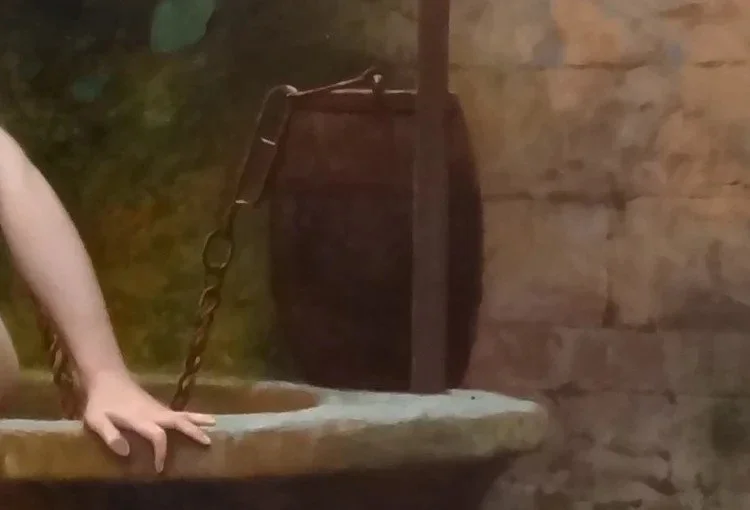
Detail of Jean-Léon Gérôme's "Truth Coming Out of Her Well to Shame Mankind"
There's a common fear, especially in matters of certain religious traditions, that supporting, much less studying, another's path risks losing your own. That engaging with a different wisdom tradition is a form of dilution, a dangerous wandering from the map you've inherited and must now accept as truth. It's a fear rooted in the understandable human impulse to protect what sustains us—to build a fortress around our beliefs, thinking it's the only way to keep everyone, including ourselves, safe. Atheists, on the other hand, often don’t feel a need to explore the mystery of what’s driven humanity throughout the ages toward some unifying element or wholeness that holds the world, and us together throughout the joys and sorrows of a lifetime.
But consider a different image of the mystery of faith: not as a protective fortress, but as a deep, singular well. The faith leaders who have strengthened my own “spiritual resilience” through time have offered wisdom that feels both timeless and urgently alive in an increasingly complex world. None of them guarded their wells by building walls. They deepened them by digging new channels, allowing waters from other sources to seep in and raise the level of their personal understanding. They realized that to truly “own” your stated position on the matter, you sometimes need to stand in a different place to see it. Here are but a few spiritual leaders I've found especially accessible and easy to learn from.
Thomas Merton, known to many Catholics as Father Louis, writing letters to others from the shelter of his Trappist hermitage, found in Zen a clarifying mirror for his understanding of Christianity; there are many monks and other dedicated spiritual leaders of Catholic and other faith traditions who feel the tenets of their faith strengthened through deep contemplation. One example of where contemplation leads us is to consider the deep questions of our own existence: what do we ever truly own? What is the nature of our attachments in life, and who are we without them? Such questions are relevant even to atheists, as each of us is subject to the deepest loss there is.
Speaking of contemplative practice with an open heart and mind, the Dalai Lama embodies Tibetan Buddhism with unwavering grace. Following his genuine curiosity about neuroscience and Jesus' teachings, he opened lines of communication with Western nations. His respect for other ways of viewing devotion and decency speaks of an unshakable confidence - precisely because it is so open. As we take in lessons and ideas, we come more surely, more solidly into our own, thus becoming the proverbial “tree planted by the rivers of waters.” Literally found in the book of Proverbs, one need not believe in traditional notions of divinity to plant oneself and become rooted in whatever genuinely comforts us.
A biblical reference like this brings to mind Rabbi Zalman Schachter-Shalomi, who forged Jewish Renewal by bringing together the disparate, yet related streams of Hasidic fervor, Sufi whirling, and Buddhist mindfulness into a more vibrant expression of his own Hasidic Jewish inheritance. He grew to encounter and express holy presence everywhere, forging alliances with religious leaders around the world.
Howard Thurman, a Protestant minister and pillar of the Black church tradition, maintained a close dialogue with Hinduism through the teachings and example of Mahatma Gandhi. Global mysticism didn't pull him from roots well-grounded in the Word, as his tradition required. Never wavering from that basis, he articulated a universal cry for freedom and love with even greater power and strength, as one may imagine Jesus himself did in his time. Today, much Protestant discourse emphasizes certain branches over others, some insisting on the prevalence of ordered words over actions and consequences. Thurman did not separate belief from acts, lest we enslave ourselves where we don’t want or need to be.
These leaders represent a remarkable constellation: each deeply rooted, yet radically open. Their lifelong engagement with other paths wasn't a sidebar to their respective faith traditions; it was integral to their evolution. They understood that studying other traditions doesn't dilute our understanding—it circumscribes it, offering new angles from which to see more than we may imagine is available to us, therefore strengthening us. It's much like understanding other languages makes us more nuanced writers in our native tongue; we become more nuanced believers. Yes, even in the face of our non-beliefs, if that's the case. The world is full of nuance, and truth is easy to miss.
Merton, the Dalai Lama, Rabbi Zalman Schachter-Shalomi, Howard Thurman, among our most rooted spiritual figures, did not lose themselves by engaging with other wisdom traditions. Instead, their openness made them more resilient and profound in their own paths. Inter-understanding doesn’t require abandoning one’s tradition; it’s about recognizing the shared human quest that animates all of them. The anxiety that this openness can provoke is real, but the challenges, the horrors of the world, remain unabated, and a deeper source of pain for many.
Note that none of the above individuals, nor those who claim them as teachers, adopted or presented ideas of exclusive communities - especially where exclusivity is a matter of survival or identity (a breach I’m afraid some atheists feel comfortable making in addressing those who find faith a source of essential comfort). And none claimed we need to be “spiritual polyglots” to deepen ourselves authentically in terms of faith.
The beauty lies in wonder, even a holy curiosity, about how we are to survive together. Why do we suffer? How do we love? What is our duty? How do we face the mystery of being? How can we, do we, judge others while committing acts of aggression (albeit perhaps passive-aggression) ourselves as we seek to dismantle and nullify others’ beliefs, if that’s something we tend to sdo?
These questions bring us to the heart of the interspiritual perspective: it doesn't ask us to abandon our traditions, but to recognize the shared human quest that animates all of them. It's a convergence: owning your own soul (or “self” if you are an atheist), claiming your personal agency, while dwelling in a collective experience.